“Charity house clearance” usually means one of two things. Either you want a charity to come and take the contents of a house for free, or you want a clearance company that gives what it can to charity rather than sending everything to landfill. Both are possible — but not in the way most people first expect.
Can a charity clear a house for free?
Only partly. Several national charities and many local furniture reuse projects will collect furniture and household goods at no charge, because they can sell them in their shops. The British Heart Foundation, for example, runs free furniture and electrical collections in many areas.
What they will not do is empty a property. A charity collection team takes the items it can sell, checks each one, and leaves the rest. Lofts, sheds, bagged rubbish, worn furniture and personal papers all stay where they are. For a house that has to be completely empty — for a sale, a tenancy handover or a council deadline — a charity collection is a first step, not the whole job.
What charities will usually take
- Solid wooden furniture in good condition: tables, chairs, wardrobes, chests of drawers, sideboards
- Upholstered furniture with its fire safety label still attached
- Working electrical items, which some charities test before resale
- Boxed kitchenware, ornaments, books, pictures and good-quality linen
- Clothing and shoes, bagged
What charities usually turn down
- Sofas and armchairs without a fire label. Upholstered furniture must carry a permanent label showing it meets the Furniture and Furnishings (Fire) (Safety) Regulations 1988. Without one, a charity cannot legally resell it, however good it looks.
- Mattresses, almost always, for hygiene reasons.
- Anything broken, stained, damp or with missing parts.
- Large old televisions and some older electrical items.
- Flat-pack furniture that has been taken apart and re-assembled several times.
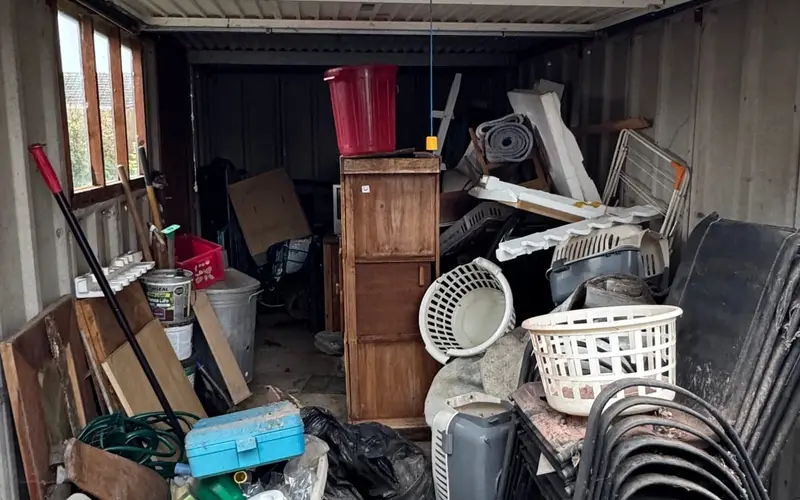
- General household waste, garden waste and the contents of lofts and garages.
Collection slots can also be booked up weeks ahead, and the team will not usually carry items down from upper floors or out of awkward spaces. If you have a deadline, check the date before planning the rest of the clearance around it.
Combining a charity collection with a paid clearance
The cheapest way to clear a house with plenty of good furniture in it is often to do it in two stages:
- Book a charity collection first for the best pieces — labelled sofas, solid wood furniture, working appliances.
- Book a licensed clearance for everything else, after the charity has been. The quote will be smaller, because there is less to take and less to pay to dispose of.
If time is short, or there is not enough good furniture to make a charity visit worthwhile, a single clearance is simpler. A clearance company that sorts as it loads will still pass on what can be reused.
How CL Clearances handles reusable items
CL Clearances sorts the contents of every property as it is loaded. Furniture and household goods in good enough condition are donated or sold on; metals and electricals go for recycling; only what is left goes to licensed waste facilities. You can read more about where each kind of item goes in what happens to furniture after a house clearance.
Whatever route the contents take, the clearance itself is carried out under Environment Agency waste carrier licence CBDU291452, and you receive a Waste Transfer Note. That matters: if you hand waste to someone who is not licensed and it is fly-tipped, you can be held responsible — see the government’s household waste duty of care guidance.
Getting a price
Send photos of the property by WhatsApp to 07783 430775, or use the contact form. Charlotte will give you a fixed written quote for a full house clearance — or for whatever is left after a charity collection.